
Puya raimondii facts for kids
Quick facts for kids Queen of the Andes |
|
|---|---|
 |
|
| Puya raimondii flowering in Ayacucho, Peru. | |
| Conservation status | |
Scientific classification  |
|
| Kingdom: | Plantae |
| Clade: | Tracheophytes |
| Clade: | Angiosperms |
| Clade: | Monocots |
| Clade: | Commelinids |
| Order: | Poales |
| Family: | Bromeliaceae |
| Genus: | Puya |
| Species: |
P. raimondii
|
| Binomial name | |
| Puya raimondii Harms
|
|
| Script error: The function "autoWithCaption" does not exist. | |
| Synonyms | |
|
Pourretia gigantea Raimondi |
|

Script error: No such module "Check for conflicting parameters".
The Puya raimondii, also known as the Queen of the Andes, is the biggest plant in the bromeliad family. Imagine a plant taller than a two-story building! Its amazing flower stalk can grow up to 15 meters (about 49 feet) high. This incredible plant lives high in the Andes mountains of Bolivia and Peru.
Contents
Discovering the Queen of the Andes
The first time scientists described this plant was in 1830. A French scientist named Alcide d'Orbigny found it in Bolivia. However, the plants he saw were young and not yet flowering. So, he couldn't fully classify them.
The plant's scientific name, raimondii, honors an Italian scientist. His name was Antonio Raimondi. He moved to Peru in the 1800s and explored many plants. He found this species and wrote about it in 1874. Later, in 1928, a German botanist named Hermann Harms gave it the name Puya raimondii.
What We Call It
In English, this plant is famously called the Queen of the Andes. People in the Andes also have many local names for it. In the Quechua language, it's known as titanka, ilakuash, kara, or santun. These names show how important this plant is to the local communities.
Amazing Features of the Queen of the Andes
The Queen of the Andes is truly a giant among plants. Its main stem, or trunk, can be up to 4 meters (13 feet) tall. It can also be 60 centimeters (2 feet) wide. This trunk is often covered by old, dried leaves.
At the top of the trunk, there's a thick cluster of leaves. This is called a rosette. Each leaf can be over 1 meter (3 feet) long. They are green on top and white underneath. The edges of the leaves have stiff, dark brown spines. These spines are about 1 centimeter (0.4 inches) long.
The Giant Flower Stalk
The most amazing part is its flower stalk, called an inflorescence. This stalk can grow 4 to 5 meters (13 to 16 feet) tall. Some have even reached 8 meters (26 feet)! When the plant flowers, the entire plant can be up to 15 meters (49 feet) tall. That's like a five-story building!
Scientists have estimated that one plant can produce over 8,000 flowers. Some even think it could be as many as 20,000! These flowers bloom over several months. They usually start in May or June and continue until December.
The individual flowers are greenish-white. They sometimes have a purple tint. Each flower has three petals and three sepals. The petals are about 6 to 8 centimeters (2.4 to 3.1 inches) long.
Life Cycle and Seeds
After flowering, the plant produces many seeds. These seeds ripen over several months. By July of the next year, they are ready to spread. Once all the seeds are ready, the giant plant finishes its life cycle and dies.
One plant can produce an incredible 12 million tiny seeds. These seeds are held in small, round capsules. Each seed is very small, only 3 to 5 millimeters (0.1 to 0.2 inches) across. The stalk that holds the fruits has a lot of resin. This means the plant can burn easily after it dies.
The Queen of the Andes lives a very long time. In its natural home, it can live for 40 to 100 years. But it only flowers once in its life. This is called being monocarpic. After it flowers and produces seeds, it dies. Unlike many other plants, it doesn't grow new plants from its roots. It relies only on its seeds for new plants to grow.
The plant's spiny leaves can sometimes trap birds. Scientists believe these spines are mainly a way for the plant to protect itself.
How the Queen of the Andes Interacts with Nature
The Queen of the Andes has a special way of life. It flowers once, produces seeds, and then dies. This is a rare strategy for such a long-lived plant. It's like a grand finale for its life!
Many birds visit the flowers. Hummingbirds and other perching birds come to drink the sweet nectar. For example, the black metaltail hummingbird lives near these plants.
Some birds even build their nests in the plant's crown. The black-winged ground dove and the Ash-breasted sierra finch have been seen nesting there. Sometimes, birds can get caught by the plant's sharp spines. This shows how important the spines are for the plant's defense.
Where the Queen of the Andes Grows
This amazing plant grows naturally in the Andes mountains. You can find it in Bolivia and Peru. It usually lives at very high elevations. This is typically between 2,400 and 4,200 meters (about 7,900 to 13,800 feet) above sea level. Some plants even grow as high as 4,460 meters (14,600 feet)!
The Queen of the Andes prefers specific places to grow. It likes rocky or shrubby slopes. These areas are often wet, like the Páramo or humid mountain forests. It tends to grow in small groups. Even if the land nearby looks similar, it might not grow there. This makes its distribution quite patchy.
-
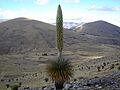
Habitat in Vacas, Cochabamba, Bolivia.
-
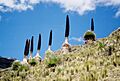
Habitat in Ancash, Peru
-
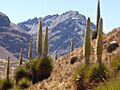
Habitat in Huascarán National Park


Protecting the Queen of the Andes
The Queen of the Andes is an endangered species. This means it is at risk of disappearing forever. The IUCN lists it as endangered.
There are several reasons why this plant is in danger.
- Fires: Fires started by humans are a big threat.
- Climate Change: Changes in the Earth's climate affect its habitat.
- Genetic Diversity: A lack of variety in its genes makes it harder for the plant to adapt.
Protecting this unique plant is very important.
Images for kids
-
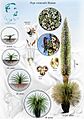
Life cycle of Puya raimondii.
-
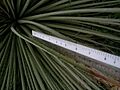
Leaves
-
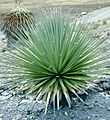
Plant
-
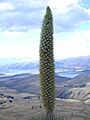
Inflorescence
-
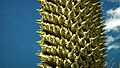
Inflorescence closeup
-
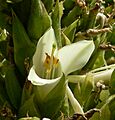
Close-up of flower.
-
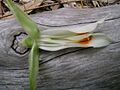
Flower dissection
-
Luigi Piacenza.jpg
with Italian botanist Luigi Piacenza


